Birgham Cemetery Survey
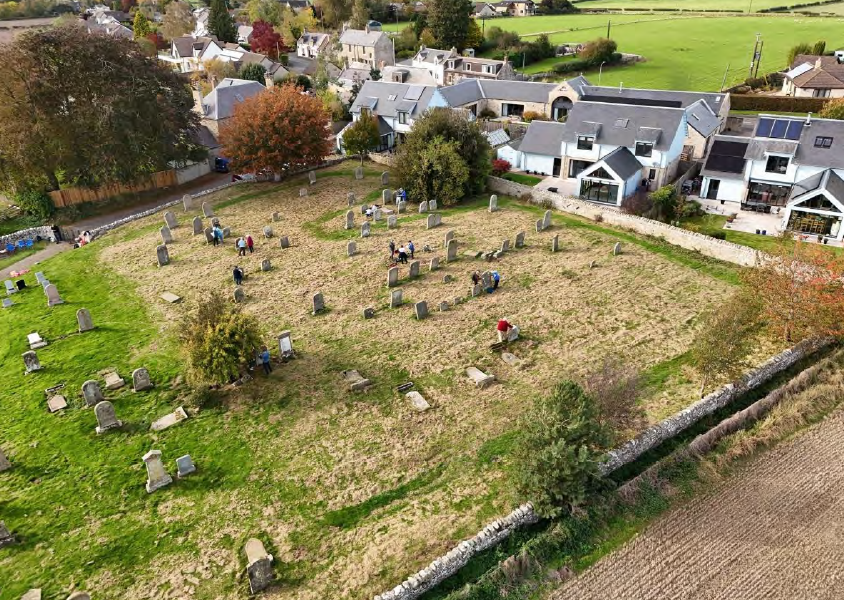
AOC Archaeology Group undertook a detailed graveyard survey over 4 days of the historic Birgham Graveyard (now known as Birgham Cemetery) in the village of Birgham near Coldstream between October 2025 and April 2026.
This strand of research was developed and delivered in partnership with Till Valley Archaeological Society (TillVAS), in particular member Pauline Hogarth, whose interest and prior research into Birgham Cemetery was the catalyst for our survey.
The results are contained within a report, available to download below.
Download Birgham Cemetery Survey Report (file size 46 MB)
Birgham’s Origins
Birgham today is a small village of around 140 people, located in the parish of Eccles between Kelso and Coldstream. It does, however, have a long history, being first mentioned in 1290 with the Treaty of Birgham concerning the intended marriage of Edward I to Margeret, Maid of Norway.
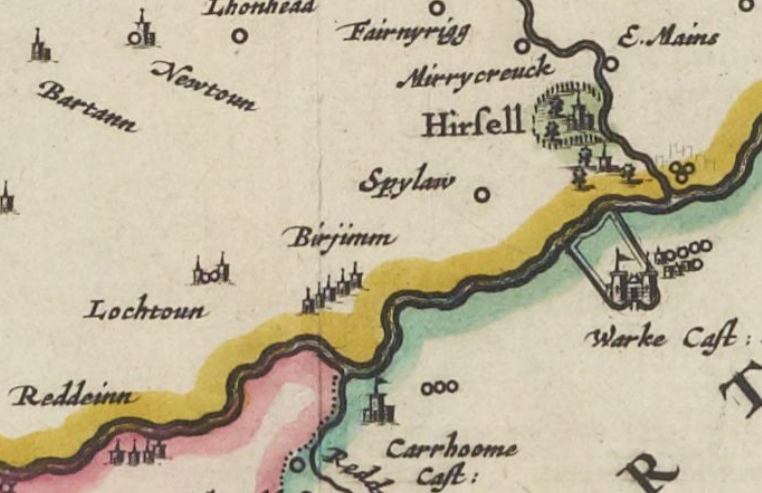
There are no known upstanding or visible remains of the medieval settlement at Birgham, the present buildings being of later 18th and 19th century date although almost certainly built over the previous existing medieval plots. It appears on Pont & Bleau’s map of ca. 1560–1614. Annotated as ‘Birjimm’ it is schematically represented as a slightly larger settlement than the ones surrounding it. The enclosed settlement of ‘Hirfell’ is noted to the north-east, and ‘Warke Castle’ to the east. Gordon’s ca. 1652 map also notes Birgham, annotated as ‘Birghame’.
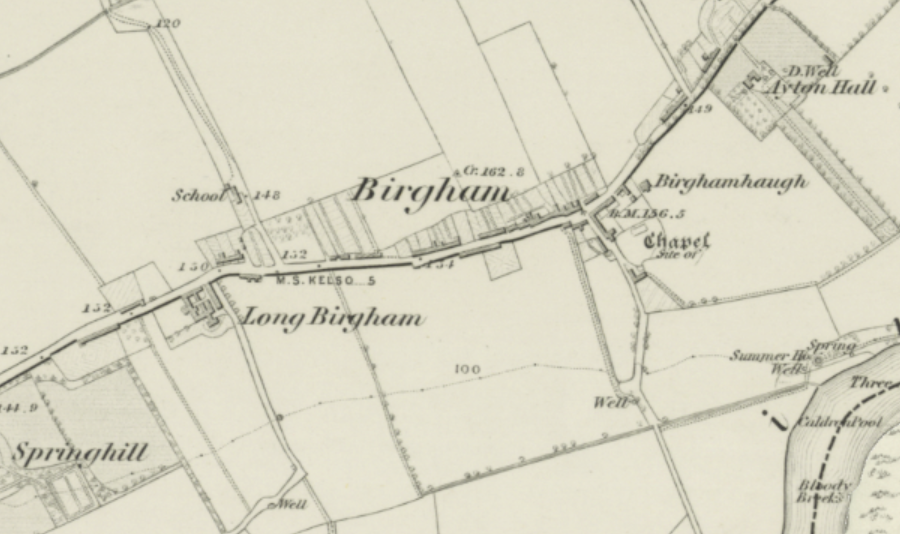
Historical records indicate that there was once a chapel at Birgham, though it was ruined by the time the more detailed maps of the 18th and 19th centuries were made. The chapel is believed to have been situated at the northern end of the cemetery.
Maps of the late 19th century depict the cemetery’s layout as it is today. The earliest upstanding burials markers date to the 17th century, though a medieval cross-slab was recorded at the site as recently as the 1960s. The location of the slab is not known today, but this record hints at the cemetery’s likely medieval beginnings.

The Survey
The team undertook a detail survey of the historic gravestones and other monuments within Birgham Cemetery. The gravestones and grave slabs were recorded using the Mytum system, a comprehensive system which considers not only at name and date, but also condition, orientation, decoration, symbology and many other details. A detailed photographic record was made, and selected memorials were recorded using photogrammetry. A detailed topographic survey was undertaken using a combination of GPS survey and UAV (drone) survey.
Overview of Results
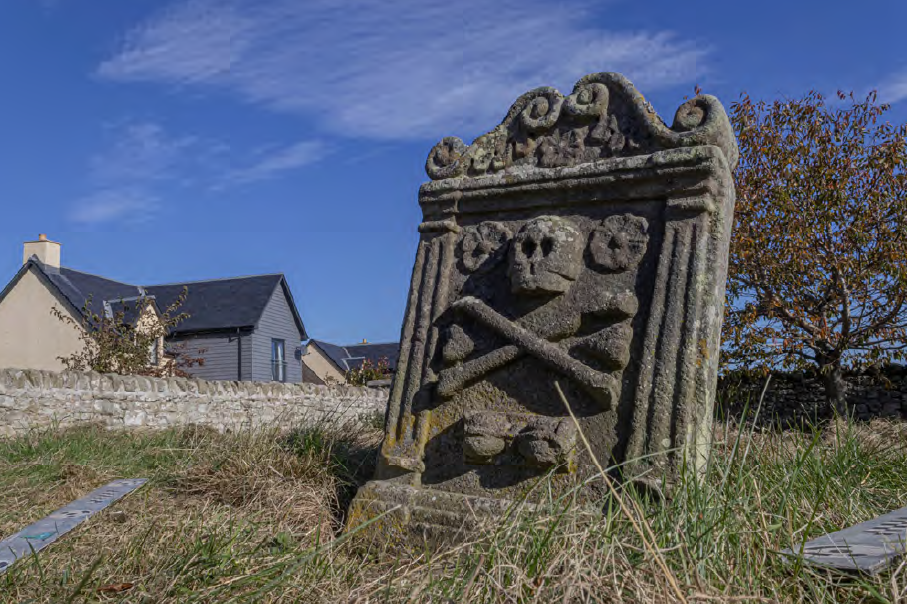
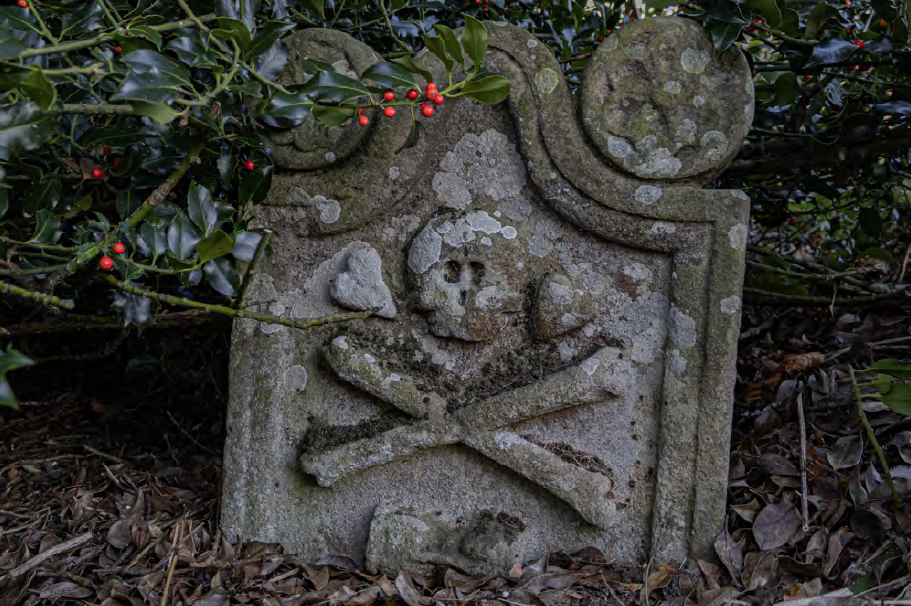
The oldest confirmed gravestones date to the period between 1596 and 1699; there are five with legible dates in this period, and a further two that may be contemporary based on the symbology on the stones. The imagery and symbolism used on these stones provides an insight into the beliefs and attitudes towards death around the 17th century. These were often more morbid in nature compared to the religious imagery of the 19th century and more plain and reserved designs of today’s gravestones.
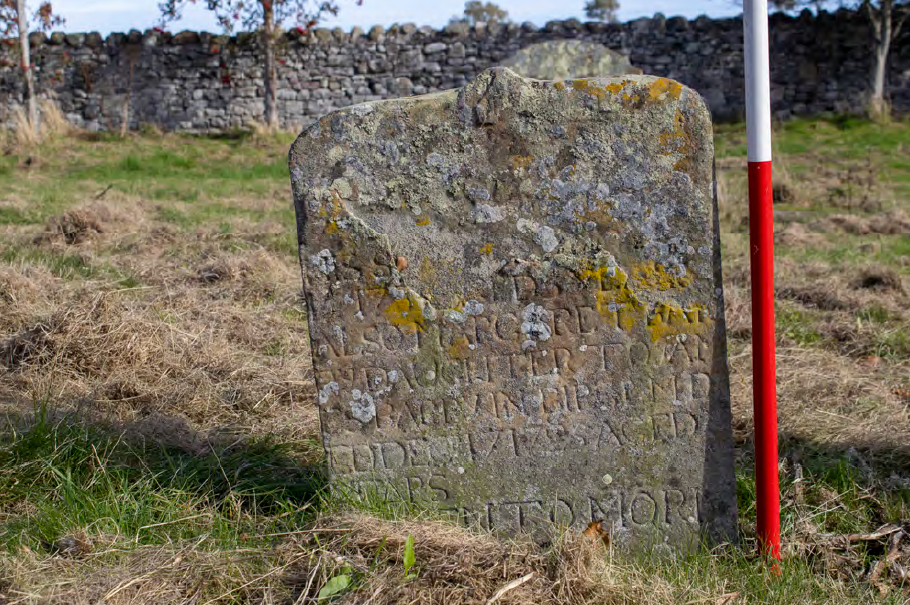
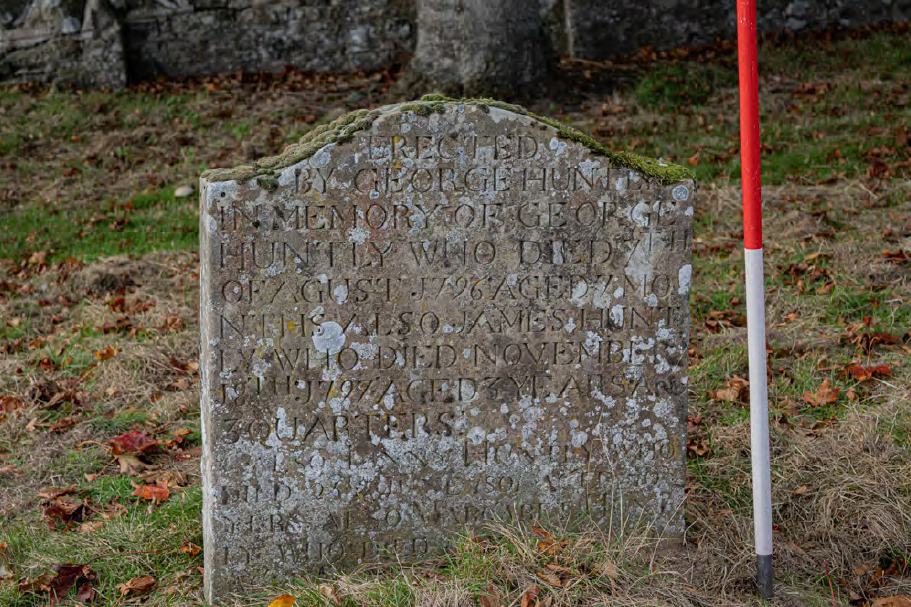
There are seventeen gravestones that were erected in the period 1700–1799. The symbology displayed on these 18th century gravestones is markedly different than that of the 17th century gravestones. There is a move towards less morbid imagery, and plainer and larger memorials. Most of the gravestones in this time period tend to be of the later post-1770s date, noting a distinct gap in the record from around 1700–1770, with only one exception.
Gravestones dating to the 19th century are must more numerous. Those from the first half of the century are plainer. By the time we reach the later 19th century the gravestones become a lot more varied in style and execution as the industry has now become well established. Most of the gravestones now have larger chamfered footings, upon which stones have been fixed. Many of the stones from this period have been laid flat for safety date from this period, as the sheer weight of the stone fixed to the footing has become less stable through time. The footings themselves were often barely sunk into the ground, sometimes on a loose base of bricks.
Moving into the early 20th century, a wide range of styles are present, and a wider variety of materials as granite begins to be used.
You can see a handful of images below, but for more detail about Birgham Cemetery including symbology through the centuries, please download the full report via the link nearer the top of the page.
Birgham Cemetery remains in active use as a place of burial and remembrance, and we did not survey modern/post-1950 gravestones.
We are grateful to Scottish Borders Council for giving permission to carry out the survey, and to Archaeology Officer Keith Elliott for his continued support.