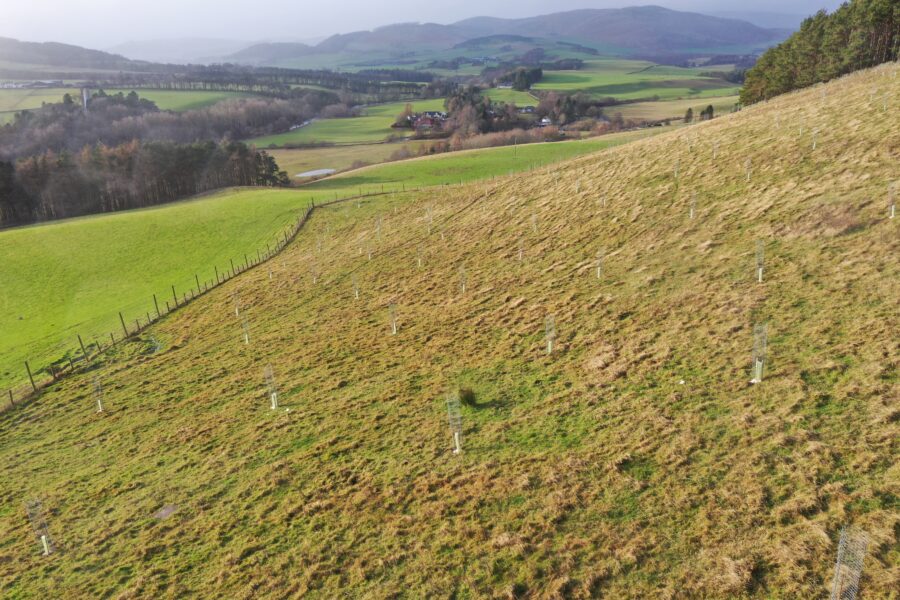
Borders environmental charity, Tweed Forum has planted more than 1,700 native trees on a Peeblesshire farm in an innovative agroforestry project that’s being delivered on a scale believed to be unmatched anywhere else in Scotland.
The approach, which has been implemented as part of the Destination Tweed river restoration initiative, is seen by many as the future of integrated and sustainable farming.
The planting, at Neidpath Farms near Peebles, integrates trees with livestock on the same land and will aid the farm business while delivering significant benefits for biodiversity and climate resilience.
Supported by funding from The Woodland Trust and Destination Tweed, the agroforestry initiative includes the planting of 65 apple, pear, cherry and plum trees, which will produce high-quality organic fruit for local markets. More than 1,000 willow trees have been planted to provide nutritious forage for cattle and sheep, supplying essential minerals such as cobalt and zinc that support animal health. A diverse mix of native alder, aspen, oak, downy birch, rowan, Scots pine and bird cherry trees has also been planted to enhance wildlife habitat, improve soil health and provide shelter and shade in pastures including a lambing field where they will protect young lambs from the elements.
The saplings are being protected from grazing livestock using a variety of methods including specialist cactus guards and electrified fencing. Wool from the farm has also been used as mulch around the base of the trees to suppress weeds and retain moisture.
The work is being carried out by Tweed Forum as part of Destination Tweed’s Woodlands for Wildlife and Water project. The wider programme will see 300,000 native trees planted across the upper catchment, largely on hill sheep farms, creating 200 hectares of much-needed native and riparian woodland.
Once established, the new woodlands will provide long-term environmental benefits including improved water quality, reduced flood risk and enhanced biodiversity. Many of the planting sites will be close to, or highly visible from, the new River Tweed Trail, enhancing the beauty of the environment for those using the new route, which is due for completion in 2028.
Tweed Forum Project Manager, Hamish Robertson hopes that other farms in the upper Tweed catchment will take advantage of agroforestry funding packages available through The Woodland Trust to undertake introduce similar measures.
He said: “This agroforestry work shows how farming, nature and tourism can work hand-in-hand to increase farm resilience, improve wildlife habitat, and contribute to the beauty of the landscape. It’s an important element of our Destination Tweed Woodlands for Wildlife and Water project and we hope other farmers will participate in similar initiatives to help create a significant and lasting legacy for hundreds of years to come.”
Matt Griffin, manager at Neidpath Farms, said; “I’m thrilled to be part of this agroforestry journey, leaving a lasting legacy on the land that boosts biodiversity, provides essential shade and shelter and creates better grazing for livestock and healthy food for local people. I want to see more trees on our farms. Trees don’t take away; they add richness, resilience and life in ways I can wait to see unfold. A big thanks goes to Tweed Forum for making this happen.”