A Mosaic of Landscapes : Ecological restoration in the Wild Heart


The Reviving the Wild Heart project spans Borders Forest Trust’s (BFT) Talla & Gameshope and Corehead & Ericstane sites. Each landscape is at a different stage of restoration, with projects, including Destination Tweed-funded work, helping to restore habitats and biodiversity.
Some initiatives are site-specific, while others, such as the montane scrub project, create ecological connections across the wider landscape.
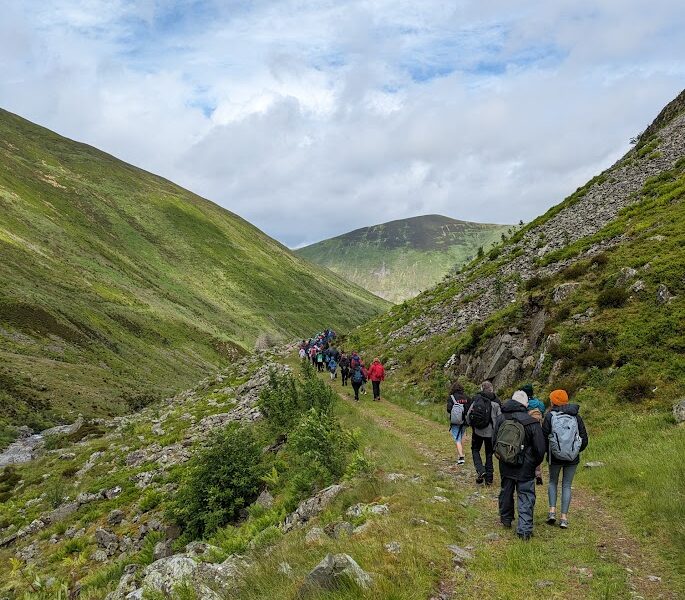
The Wild Heart sites lie within the dramatic upland landscapes of the Moffat Hills in southern Scotland, an area of steep glens, rolling moorland, peatlands and headwater streams that form part of the wider River Tweed catchment.
Together, Wild Heart sites create a connected landscape of more than 3,250 hectares. Historically, these hills would have supported extensive native woodland, montane scrub and rich peatland habitats. These sites have been degraded by centuries of grazing on fragile hill land.
Through woodland creation, peatland restoration and habitat connectivity, the area is being transformed into a richer and more resilient landscape for both people and wildlife.
Below are some examples of the environments which Borders Forest Trust are reviving with the help of a team of volunteers and contractors as part of the Destination Tweed project.
-

Native woodland restoration
Borders Forest Trust has been restoring native woodlands in the Southern Uplands for over 25 years, and restored valleys are now filled with the song of returning birdlife, the colour of woodland flowers such as wood anemone, primroses and wood sorrel, and pollinators of all shapes and sizes buzzing with life. Planted 26 years ago, the trees at Carrifran are now reproducing on their own, berries clad the juniper, small oaks, hazel and birch are popping up in the understory, regenerating willows cling to shingle in the streams and aspen is suckering with vigour.
Planted just this year, with the help of volunteers, our newest woodland at Ericstane, has been created with climate change in mind. It includes more southerly species such as alder buckthorn which we hope will support invertebrates such as the brimstone butterfly as warming temperatures force them to move north.
-

Montane scrub restoration
This high-altitude woodland had been largely lost across Scotland, and restoration work on mountains across the country has seen it come back from the brink of extinction over the last few decades. Across BFT’s 3, 250ha Wild Heart, over 80,000 montane shrubs have been planted, most recently through Destination Tweed. Species such as downy willow, tea-leaved willow, prostrate juniper and dwarf birch form an important upland plant community mosaic. Along with the natural resurgence of tall herbs such as valerian, meadowsweet, angelica and goldenrod and the recovery of boreal heaths of heathers, blaeberry, crowberry, cowberry and cloudberry this montane scrub planting is recreating an upland world full of life.
-

Grassland restoration
Collaborating with Buglife’s Pollinators Along the Tweed project, also part of the Destination Tweed project, wildflowers and wetlands are being restored in Corehead’s in-bye fields where wildlife scrapes have been created seeing the return of damselflies, dragonflies and wildfowl. In the semi-improved fields, fertility is being reduced through cutting and removing grass in late summer, while yellow rattle parasitises the grasses, making way for the return of orchids and other wildflowers. This natural succession has been boosted by the sowing of wildflower seed and the planting of thousands of wildflower plug plants by volunteers; including ox eye daisies, cranesbills, clover and the late flowering pollinator favourite devil’s bit scabious.
This project is supported by funding from the National Lottery Heritage Fund, Fallago Environment Fund and other funders.