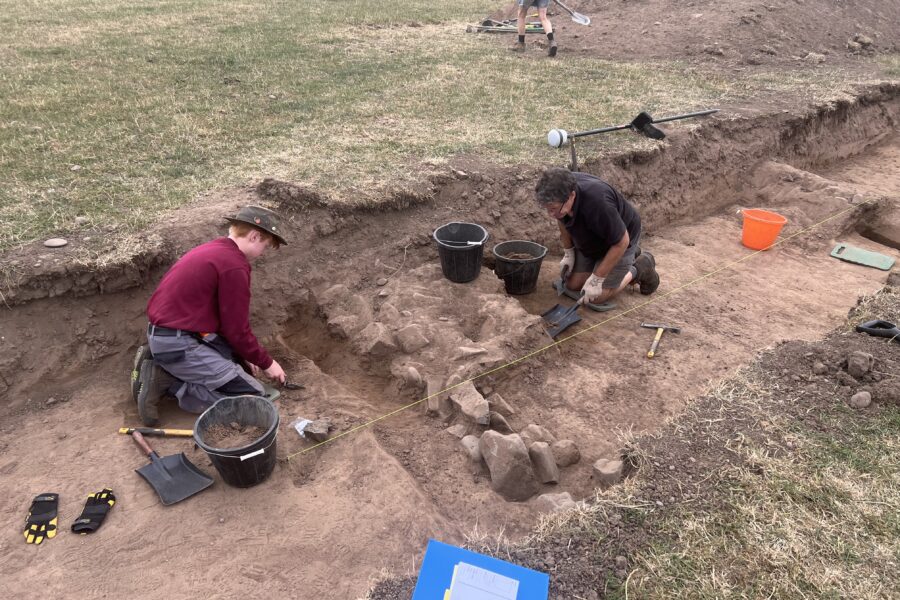
Archaeologists and volunteers from Destination Tweed’s community-based archaeology programme, Uncovering the Tweed have begun a three-week excavation at Whitmuirhaugh, Sprouston near Kelso to discover how the site has been used over thousands of years.
The location is a Scheduled Monument with evidence suggesting activity from early pre-historic period through to the medieval era. While a thorough survey of the site has been undertaken, it has never previously been excavated. The dig represents the most substantial piece of fieldwork undertaken as part of the three-year Uncovering the Tweed project, which is investigating important sites of activity along the River Tweed and surrounding area, close to the route of the planned River Tweed Trail.
Community volunteers have played a vital role throughout the project, working alongside specialists from AOC Archaeology Group to help uncover and better understand the region’s rich heritage. The project is funded by The National Lottery Heritage Fund, Historic Environment Scotland and the Fallago Environment Fund.
The Sprouston site was first identified through aerial photography in the 1980s. Subsequent analysis of aerial imagery and geophysical surveys suggest that it includes a Neolithic causewayed enclosure, an Iron Age fort and an Anglian town, making it one of the most intriguing archaeological sites in the Borders.
Cathy MacIver, Project Manager at AOC Archaeology Group said; “Sprouston is an exceptionally exciting site with the evidence gathered so far suggesting it has been an important focal point in the landscape for thousands of years. Its location right beside the River Tweed, but on a raised gravel terrace less likely to flood and within easy reach of fertile farmland, seem to have made it a desirable settlement location. Excavation is the best way to try to really understand the site so we’re looking forward to working with our volunteers to see what discoveries emerge over the coming weeks.”
Destination Tweed Project Officer, Charlotte Douglas, said; “The Uncovering the Tweed project is testament to the enormous enthusiasm that local communities have for exploring and celebrating the rich heritage of the Tweed. From getting involved with excavations to carrying out research into everything from prehistoric settlements and medieval towers to historical river crossings and deserted medieval villages, volunteers have made a significant contribution to our understanding of the area’s past. We hope that any discoveries made at Sprouston will not only enhance archaeological knowledge but will also inspire more people to connect with the incredible stories and landscapes of the River Tweed.”
Dr Susan O’Connor, Head of Grants at Historic Environment Scotland, said: “Uncovering the Tweed and other community-based archaeology initiatives are vital for improving and sharing our understanding of Scotland’s history. It also gives people a sense of pride in their local heritage, though when you live near an area with such rich history as the River Tweed, that isn’t hard! We are delighted to support this project and look forward to the findings being shared in due course.”