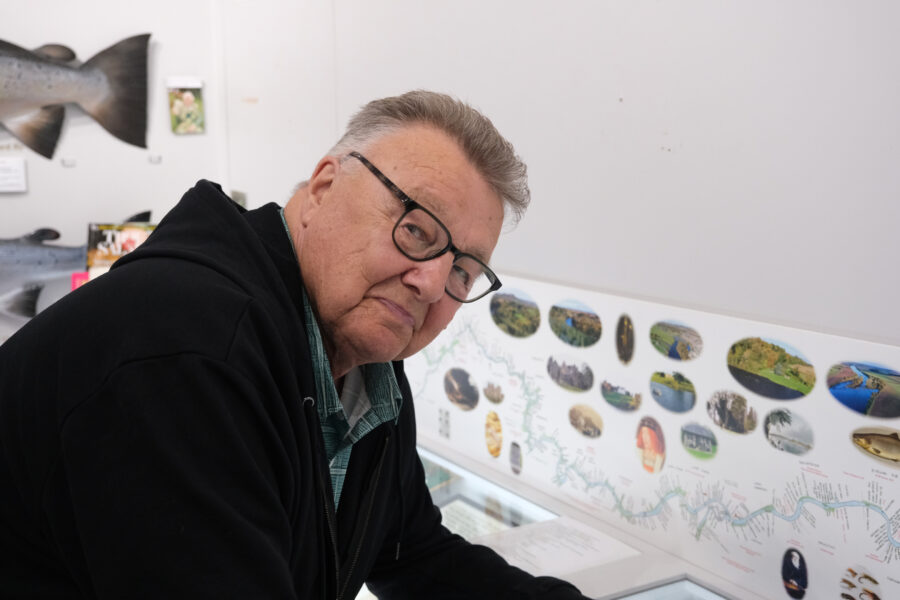
Extract from an interview with Maurice Kukk who volunteers three days a week at the River Tweed Salmon Fishing Museum in Kelso. As part of the Tweed Stories project, oral historian, Harry Henderson recorded Maurice at the museum.
Maurice was born in Coldstream in the early 1950s and brought up on a farm just over the Tweed at Wark Common in North Northumberland. He says, ‘history begins where you are standing and you work outwards from there’. He recounts events on the river in the distant past.
The ball field. It was a field at Learmouth Road end between Wark and Cornhill. The game was between Coldstream in Scotland and Wark in England. You had to get the ball from this field across the Tweed onto the church steps of Coldstream or Wark. It was a cross between rugby, football and you name it. Coldstream outgrew Wark so Coldstream kept winning the field. So Coldstream now owns a field in England across the border. And it still belongs to Scotland. It’s part of West Learmouth Farm. I’ve spoken to the owner, it’s always been difficult when it’s been bought and sold. It’s a bit like no man’s land.
I reckon the Tweed used to be tidal a lot further up, because when Roxburgh was thriving, you used to send the boats down, sail the boats down to Berwick with the wool, and you could get them so far up tidal and just pull them up the rest with a horse. And it was a massive trade from Roxburgh from the thirteen, fourteen hundreds, right up till Berwick was retaken by the English. The traders couldn’t trade. So they left Roxburgh and moved back to Edinburgh and wherever, Perth. Roxburgh could have been the capital of Scotland. It had a royal mint, it had churches, it had schools, it had streets. Now there’s nothing left but the ruins of the castle. That was a big part of the Tweed then, the wool trade, but it’s all gone.