From Control to Recovery: Tackling Non-native Invasive Species Across the Tweed
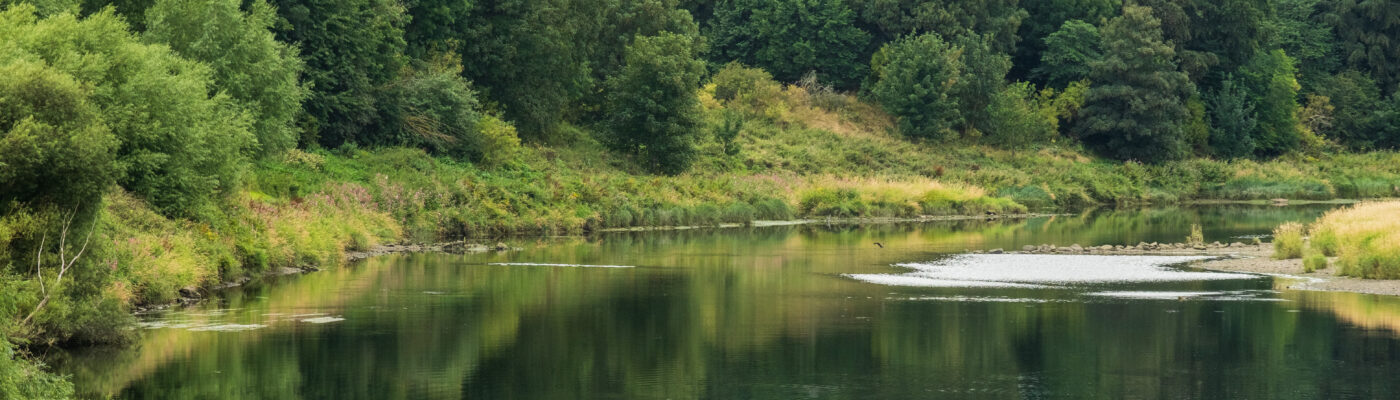

Established by Tweed Forum in response to strong public demand, the Tweed Invasives Project has been running since 2002, aiming to monitor, remove and control the threat of invasive non-native species (INNS) in the Tweed Catchment.
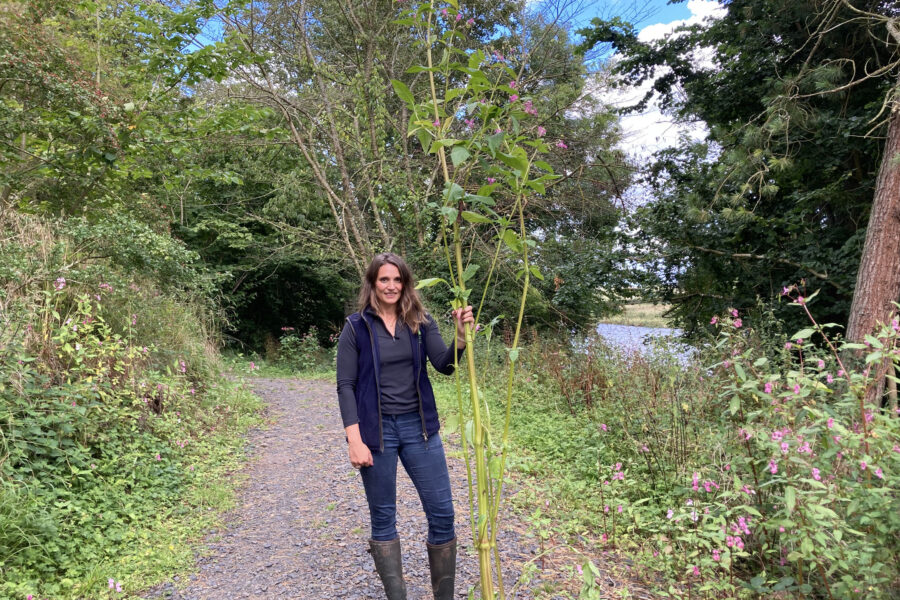
More than two decades on from its launch, the INNS project has developed into one of the UK’s largest and most successful invasive non-native plant control programmes, covering around 5,000 km².
The project initially focused on controlling giant hogweed before expanding to tackle Japanese knotweed, Himalayan balsam, American skunk cabbage and Pirri-pirri-bur. Introduced as Victorian garden ornamentals, these invasive plants have spread throughout the wider catchment, particularly along rivers and ditches. Their ability to reproduce rapidly through seeds or vegetative growth allows them to quickly dominate habitats and outcompete native plants.
This case study examines a sample of sites in the Tweed Catchment, where sustained control measures have made a visible impact to the environment, particularly in the control of Giant Hogweed, an invasive plant that contains chemicals harmful to humans and wildlife.
Data was obtained from the most recent Botanical Monitoring Survey (June 2026), where each site was surveyed through 6 randomly selected 4 x 4m quadrats, photographed and compared to previous survey findings. Quadrats were divided between areas where INNS had been controlled and adjacent semi-natural vegetation, allowing comparison of how native vegetation was recovering.
Norham Bridge
Target species: Giant Hogweed
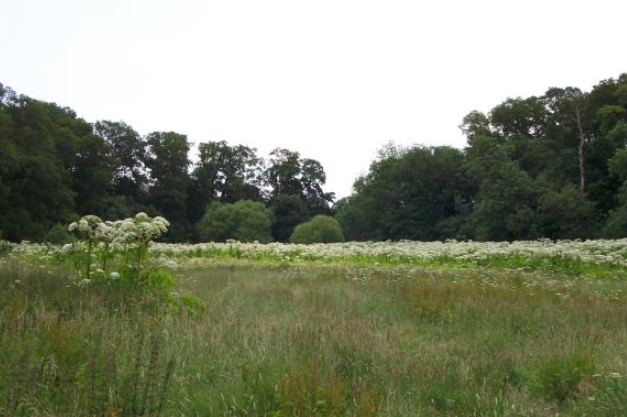
In 2008, Giant Hogweed dominated the site located on the south bank of the Tweed upstream of Norham Bridge and adjacent to an arable field. Following years of control measures there has been a significant change. No new Giant Hogweed has been recorded since 2014, a major accomplishment for the project.
Native vegetation is now becoming well established, with willow, elder and bramble spreading across the site alongside dense areas of comfrey and stinging nettle. Himalayan Balsam, which was recorded in 2024, was not found during the 2026 survey. The increasingly dense vegetation may be helping to prevent new seedlings from becoming established.
The river has continued to erode the lower bank, making parts of the site inaccessible for monitoring. However, observations from the top of the bank show that trees and shrubs are now well established, and the area is gradually developing towards open woodland habitat.
Springwood, Kelso
Target species: Giant Hogweed
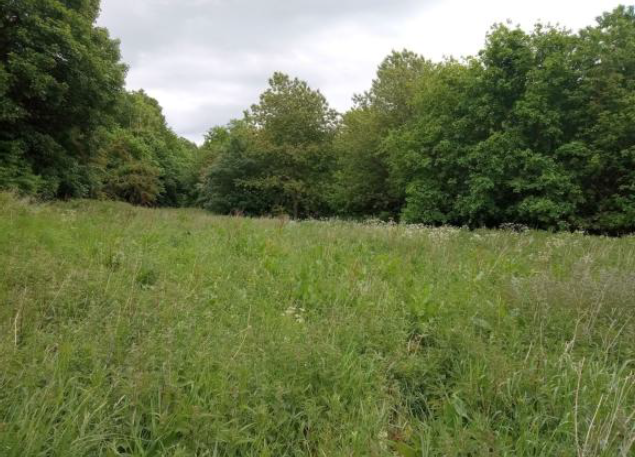
Along the south bank of the River Teviot, the Tweed’s largest tributary, Giant Hogweed was originally the main species targeted for control, but no plants were recorded during the latest survey. The species was last found and treated at the site in 2020, and its continued absence indicates that the control programme has been successful. There are also positive signs within the wider plant community with grasses and native species such as red campion, sweet cicely and hedge woundwort increasing in cover since the previous survey. These changes, alongside the continued absence of Giant Hogweed, help demonstrate what can be achieved through consistent, long-term intervention.
However, the site also demonstrates why ongoing monitoring remains important. Himalayan Balsam continues to be present, although its distribution has reduced since the 2024 survey. While this is encouraging, its continued presence means that further monitoring and control will be needed to prevent it spreading or increasing again. This illustrates that invasive species management is an ongoing process, requiring repeated surveys, early detection and continued control to maintain progress and give native riverside vegetation the opportunity to thrive.
-
Before
After
Norham Bridge 2008 vs 2026.
-
Before
After
Springwood Kelso 2015 vs 2026.
Nun’s Walk and The Leet, Coldstream
Target species : Giant Hogweed and Japanese Knotweed
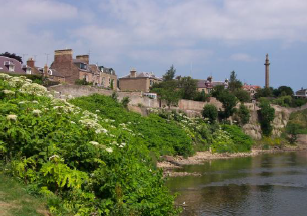
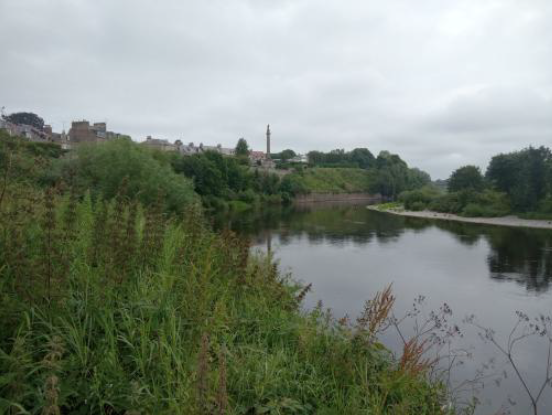
The Nun’s Walk site in Coldstream is a very steep bank on the north side of the Tweed beside a well-used public path within the town. It has been monitored for INNS since 2014, when Giant Hogweed was the main target for control. Continued management appears to have been successful, with no Giant Hogweed recorded during the latest survey, although plants remain present on the opposite side of the river in Northumberland.
The survey did, however, identify Japanese Knotweed and Himalayan Balsam, neither of which had been found at the site in 2024. Changes in the wider vegetation may be to blame for this spread as bramble has expanded considerably across the site, while increasing tree and willow cover has created areas of shade and patches of bare ground where INNS have taken root in some of these disturbed areas.
The site highlights the importance of long-term management, where successful control is not the end of the process but needs to be followed by regular surveillance to prevent invasive plants becoming re-established and spreading further.
At the Leet, a closed canopy of broadleaved woodland on a floodplain on the east side of the watercourse, the latest survey found no Giant Hogweed or other target invasive species, showing the positive results of long-term control.
The site is now a mix of woodland and open grassland. Beneath the trees, plant diversity has increased slightly since 2024, possibly as the closely planted woodland naturally thins and more light reaches the ground. In the grassland, stinging nettle and creeping thistle remain dominant, but a wider variety of flowering plants and grasses is also becoming established including red campion, white dead-nettle, crosswort, common sedge and meadowsweet.
The decline of Giant Hogweed is particularly positive as the site is close to housing and is regularly crossed by local walkers, making it a safer and more welcoming area for the community.
Horncliffe
Target Species: Giant Hogweed
The Greenhill site lies on the south bank of the Tweed near Horncliffe, where Giant Hogweed was previously found growing along a ditch and old hedgerow. No Giant Hogweed or other target invasive species were recorded in either the 2024 or the latest survey.
Since treatment, the vegetation along the ditch has gradually changed as other plants have recolonised the area. Bramble, grasses and other native vegetation are now well established, while the neighbouring grassland is becoming increasingly rich and varied. A growing range of wildflowers and grasses has been recorded, including clovers, crosswort, ribwort plantain and sorrel, with orchids also spreading across the wider area.
Controlling Giant Hogweed along the ditch and hedgerow has prevented it from spreading further across the surrounding land, while allowing a healthier and more diverse habitat to develop.
-
Before
After
Horncliffe 2008 vs 2026.
Newton Don
Target species – Japanese knotweed
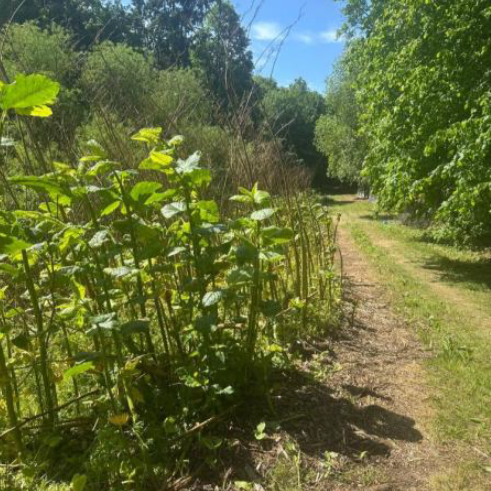
A new site for 2026, Newton Don, north of Kelso, contains areas of Giant Knotweed, probably originally introduced as an ornamental plant for the estate’s historic Japanese water garden, planted in the 1800’s and now vanished. Giant Knotweed has become well established in parts of the wooded valley, with vigorous growth reaching around three metres in height.
Initial control work has begun, but the plant’s ability to regrow quickly means continued treatment and long-term monitoring will be essential. Of particular importance is preventing it from spreading further along the watercourse and eventually reaching the Eden Water. There is currently no evidence that it has spread this far.
The survey also demonstrates the impact Giant Knotweed can have on other vegetation, forming dense growth that can smother native plants. In nearby areas without knotweed, a much greater variety of woodland and grassland plants is able to thrive, including primrose, violets and a range of native grasses and wildflowers. Ongoing control therefore offers an opportunity both to contain the Giant Knotweed and allow more diverse native habitats to recover.
Conclusion
Together, these sites demonstrate the value of long-term, consistent management of INNS across the Tweed catchment. At locations where Giant Hogweed once dominated, years of targeted control have greatly reduced or eliminated the species, allowing native vegetation to return and more diverse riverside habitats to develop.
The results also show why continued monitoring is essential. Invasive plants can reappear, spread from neighbouring areas or establish at new sites, as seen with Himalayan Balsam and knotweed. Regular surveys allow these changes to be identified early and action taken before species become more widely established.
By controlling invasive plants across the catchment, the project is helping to protect the River Tweed and its tributaries, support native biodiversity and creating healthier, more resilient riverside habitats. More than two decades of work show that sustained intervention can bring lasting change, but also that maintaining these gains depends on continued monitoring, early detection and ongoing control.
The INNS project was made possible by funding from multiple funders including National Lottery Heritage Fund Scotland, Fallago Environment Fund and the LIFE WADER project.