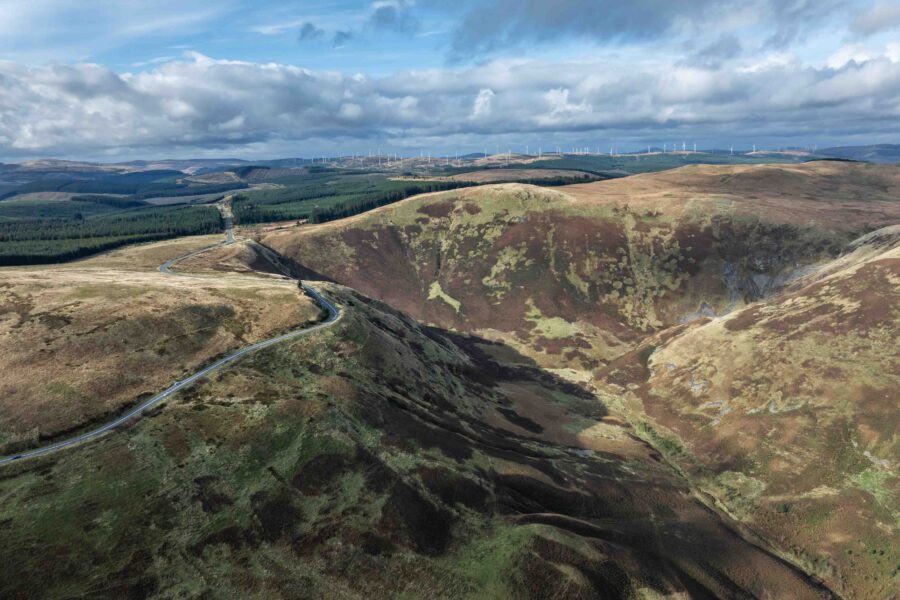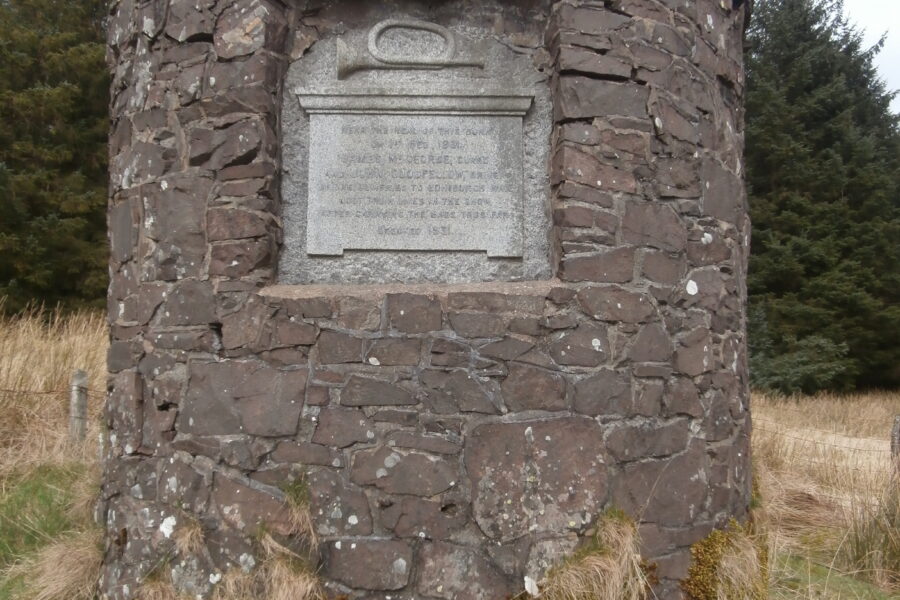
There is a memorial in the shape of a cairn beside the A701 travelling to Moffat, before the Devil’s Beef Tub. It was erected in 1931 at the behest of the then Tweedsmuir Minister, Rev Dr Crockett, on the centenary of the tragic event that it commemorates. Rev Crockett had known an old man who, as a boy, took part in the search and from whom he heard the story. He thought it a shame that there was no adequate monument to the actions of the Guard and Driver of the Dumfries to Edinburgh Mail Coach on 1st February 1831, which led to the death of both men.
The story is that the mail coach from Dumfries with about 100 lbs of mail and a few passengers had, despite bad weather, arrived at The Star Inn in Moffat. Locals, knowing that the weather was deteriorating fast and that blizzard would be gripping the high ground before Tweedhopefoot, were against continuing. Most passengers heeded the advice and stayed the night, but two ladies, The Misses Cruickshank, anxious to attend to family business in Edinburgh, rejoined the coach when the Guard announced he would ignore the warnings and go on.
The coach, with fresh horses, headed out towards the next Inn at Tweedshaws, accompanied by two roadmen for the first part of the journey, who were very useful when the coach became fast in a snow drift after a few miles. It was then decided that the ladies should return to the Inn. The Guard, James McGeorge, was strongly counselled to do likewise but he insisted that the mail would be carried through no matter the weather. John Goodfellow, the coach driver, said that he would go wherever his guard went. Two horses were unhitched, returning with the Misses Cruickshank and the roadmen to Moffat, while the other two horses headed off to the darkening hills with the two coachmen, the foreman roadman and the mail bags.
Another couple of miles were arduously completed as a dark moonless night fell upon the snow-covered hills. The horses, tired beyond their capacity, refused to move further. The foreman, James Marchbanks, and the Driver, John Goodfellow were for returning with the horses, but Guard McGeorge would hear nothing other than going on. John Goodfellow eventually turned to his friend and Guard, saying “If ye gang I gang”. Marchbank set off to Moffat alone. Goodfellow and McGeorge headed into that blizzard with the reluctant horses, comforted by the knowledge that Tweedshaws was but three miles distant. Foreman Marchbanks was warmly greeted in Moffat on his return late at night but his tale turned to despair when news came that two horses had managed to find their way alone to Corehead Farm at the base of The Tub.
Early next morning James Marchbank set off to Tweedshaws hoping that he would find his two erstwhile companions there. A mile beyond the Tub he saw a mail bag badge glinting in the winter sun against the snow. The mail bags were secured very tightly to a fence post, which bore the blood of the fingers that had tied the bags to it. Still hoping, he set off to Tweedshaws but with only a mile to go realized that passage was impossible. It was dark before he made Moffat again. The next morning, Thursday, at least 150 men went out to search, the storm having all but ceased but they found nothing. They searched all day Friday but only found the driver’s cape and hat in a peat hag high on the moor.
On the Saturday the innkeeper at Tweedshaws and a local herd set out from the Inn and searched an old seldom-used Tweeddale track. After a short while they saw a black booted foot sticking out of the white of a deep drift. Digging down they found Driver Goodfellow lying on his back. A hundred yards away Guard James McGeorge sat against a fence post as if asleep with “a kind o’a pleasure” on his face. It was thought McGeorge had stayed with Goodfellow till he died and then tried to save himself, but his strength gave out. Both men were buried in Moffat on the Wednesday, at a service attended by many folk from the town and surrounding farms.
Read more about this story, and many others from the upper reaches of the Tweed, at www.tweedsmuir.scot/history/.
Images: The mail-carriers’ memorial © John Lord (cc-by-sa/2.0) geograph.org.uk/p/3923212; The Devil’s Beeftub by Airborne Lens.