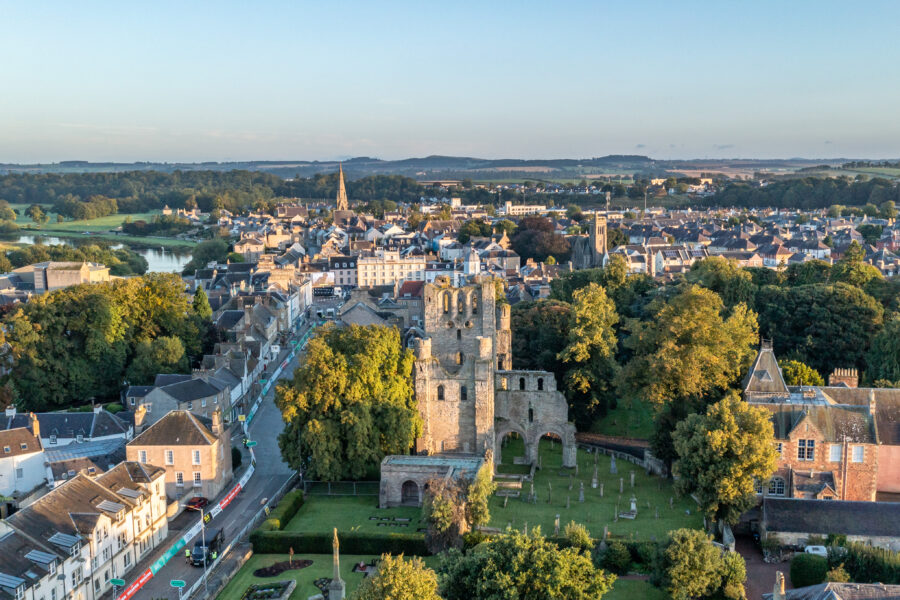
Kelso Abbey was founded in the 12th century by Tironensian monks during the reign of Alexander I, and once stood as one of Scotland’s most powerful monastic houses. Overlooking the meeting of the Tweed and Teviot rivers, it occupied a strategic site near Roxburgh, the intended southern stronghold of the emerging Scottish kingdom.
This abbey was more than a religious centre; it was a symbol of authority and ambition. Its massive Romanesque design, with formidable towers and semi-military strength, reflected the importance of Roxburgh and the abbacy’s influence. At its height, Kelso Abbey was among the richest and most prestigious in Scotland.
But its position near the border made it vulnerable. From the 14th century onward, Kelso endured repeated attacks and destruction during Anglo-Scottish conflicts. Though the monks rebuilt time and again, the turbulence of the early 16th century and the Reformation brought its decline. By the mid-1500s, the abbey had ceased to function, leaving behind the imposing ruins we see today, chiefly the great west tower crossing and part of the infirmary.
Today, Kelso Abbey is a haunting reminder of medieval power and faith, and a highlight of the Borders Abbeys Way, a 107km trail linking Scotland’s four great abbeys – Kelso, Melrose, Dryburgh, and Jedburgh.