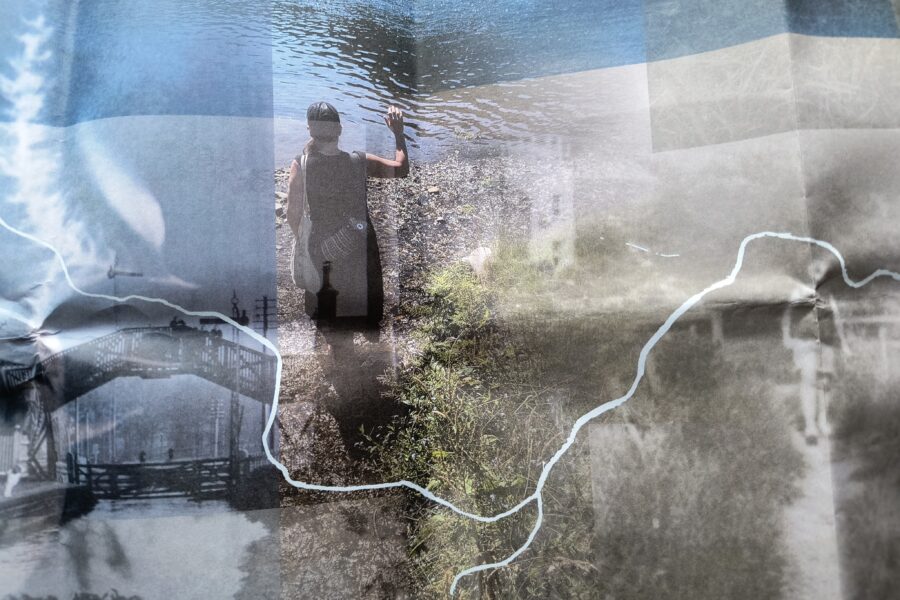
I recently read a book which talked of places that exist beyond any map, and it got me thinking. If you look at a map of the River Tweed, you’ll see how to travel from one point to the next, but it doesn’t tell you that up on the high street was a shop run by Miss Clark that sold hand knitted children’s clothes that everyone in the village can remember, either from memory or through folklore.
In this part of the Tweed the burn and the river made the mills. As the industry grew, the river swelled and flooded to make the lade and the towns brought work for people like Robert, who takes his tea black. Across from the manmade forest where cyclists and walkers begrudgingly share the path, we heard of plants and flowers along the riverbank becoming imagined playthings of childhood; saw a flower stuck on a rock like a little prize waiting to be found or left in ritual as a reminder of the past. We learned that the flowers of the lime tree are good for pain relief and are also known as drumsticks, and did you know that yarrow was worn by soldiers for protection in battle?
As the river flows on it carries a story of a bond made over that same said yarrow that shifted the direction of Doreen’s life, from far-off shores to here, where she made a home and family and convenes with the Yew tree.
Image: © Jim Barton (cc-by-sa/2.0) geograph.org.uk/p/7494317
Old weir and salmon ladder, Walkerburn