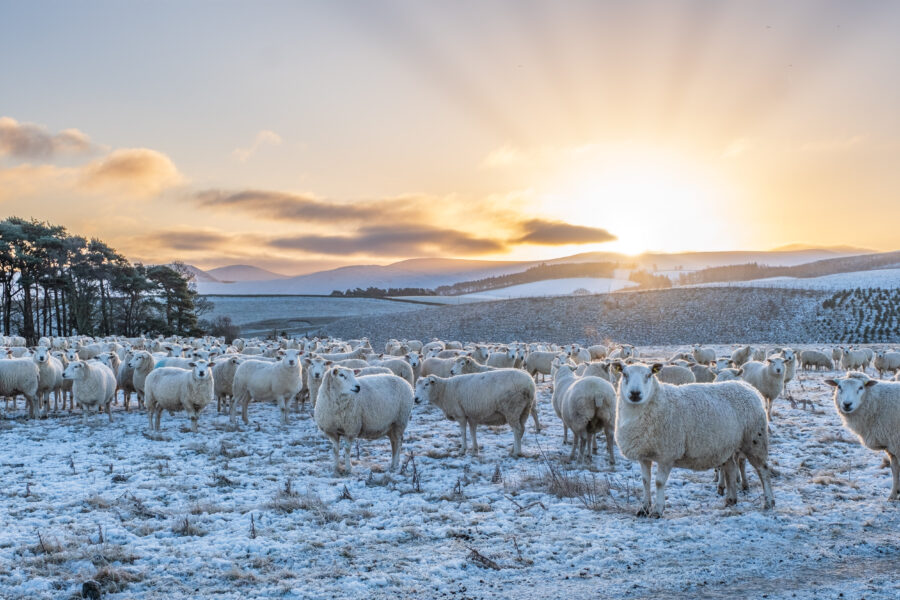
From the earliest Neolithic settlers to modern-day artisans, sheep farming has shaped the region’s economy, culture, and landscape.
Powered by the river, and later wind and steam, early mills transformed local wool into high-quality textiles sold across the globe. The hardy Border Cheviot sheep, bred in the uplands of Ettrick, Yarrow, and the Cheviot Hills, became central to this success—valued for both their wool and resilience.
The monks of Melrose Abbey were pivotal in expanding sheep farming during the 13th century. By the 1280s, they managed flocks exceeding 13,000 sheep, the largest in Scotland at the time. Their estates across Ayrshire, Galloway, the Lothians, and Berwickshire became major centres of wool production.
Place names like Ewelairs Hill and Wedder Law reflect the deep-rooted sheep farming heritage of the region. In fact, between the 13th and 15th centuries, Scotland was second only to England as a wool-producing nation.
The Industrial Revolution brought intensified sheep farming, driven by rising wool demand, and saw Borders towns like Galashiels and Hawick thrive, producing iconic tweeds and blue-dyed wool. By the early 1830s, the textile industry employed almost three-quarters of Scottish workers.
The industry has evolved and declined somewhat in recent years, however, sheep farming remains a defining feature of the Borders. Local mills such as Lovat Mill, Lochcarron, and The Border Mill in Duns continue to use native wool, crafting beautiful, regionally inspired pieces. Global brands like Chanel, Ralph Lauren, and Brooks Brothers have all sourced textiles from Borders towns.
While the industry’s scale and methods have evolved, the cultural imprint—from architecture to place names—continues to shape the region’s identity.