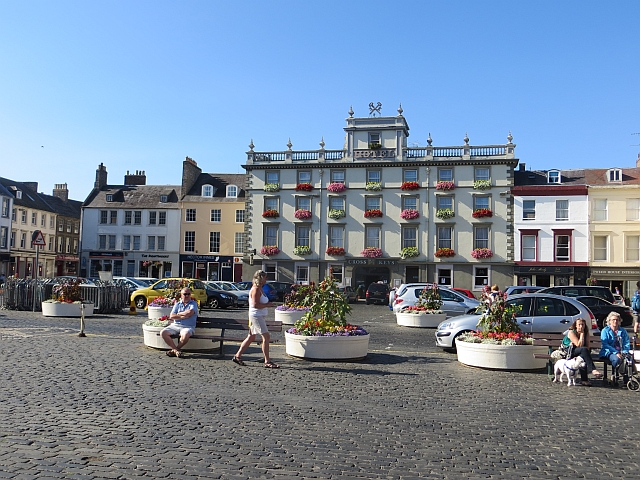
The Cross Keys Coaching Inn, in the centre of Kelso, was built by James Dickson of Ednam House in 1769. It was a well-patronised coaching inn when Kelso became a staging post for those travelling between Edinburgh and London. Coaches would pass under the (now built up) main front entrance of the hotel on Kelso Square to a stable yard behind and could uplift and set down their passengers under cover.
Horse-drawn coaching services from Edinburgh to London were advertised from the mid 1700s onwards. The journey took ten days in summer and twelve in winter to cover the 400+ miles by coach. At 40 miles a day and at an average speed of 5mph, that’s an eight hour day continuously trundling and bumping along. The horses would need to be changed regularly to maintain that speed, probably in ‘stages’ every 15 miles or so at coaching hostelries – hence the name ‘stagecoaches’.
Horse-drawn coaches (including the mail coach) ran from the early 1700s up to the mid-1800s, when the railways made train travel much faster and more comfortable. The railway heyday was between 1850 and 1920, when charabancs, motor coaches and cars gradually supplanted them. After World War II, motor cars became the most popular mode of transport.
In 1825, The Kelso Mail presented the Kelso stagecoach services as an example of ‘the general changes and improvements of a country…, contrasting the advantages enjoyed at the present moment with the inconveniences suffered at a former period’.
The article explained: ‘About thirty years ago the only conveyance which left The Cross Keys Inn and proceeded from Kelso to Edinburgh was a heavy coach, denominated ‘The Fly’. This coach set off at eight in the morning and reached Edinburgh, a distance of 41 miles, between six and seven in the evening, occupying, certainly never less than ten hours. In winter, we believe, it ran twice a week only and frequently did not reach its journey’s end till eight in the evening, or twelve hours on the road.
The addition of another horse was afterwards made, by which a certain degree of improvement was effected; but, for many years this lumbering vehicle was all the public had to rely upon. Ultimately The Fly was changed for The Tweedside four-horse coach,
every way better-appointed, and more expeditious. This change took place about ten years ago.
In the year 1815, The North Briton, London & Edinburgh coach (now running as The Wellington, three days in the week) commenced passing through Kelso every day performing the journey in six hours.
Next, The Commercial Traveller started from Coldstream by Kelso three days a week with two horses; and immediately thereafter, started from Kelso The Royal Express with three horses, running alternate days with The Tweedside. These last mentioned coaches usually performed the distance in about seven hours and a half. And last came the London and York Royal Mail which has run about six months, performing the distance in less than five hours.
Thus in place of the old solitary Fly, drawing its way three days a week in ten hours to the city, there are five excellent coaches, with a choice of three every day, on the road and the distance performed in less than half the time of The Fly. Formerly, there was no intercourse between Kelso and the other towns in the district; now there is a coach from Berwick, another from Hawick by Jedburgh, and another from Dunse; by which a connexion with the three great lines of road from London to Edinburgh is kept up.
All these coaches (the one from Coldstream excepted, which goes to the King’s Head) arrive and depart from the same inn, the Cross Keys, from which the original Fly took its departure and, on market days, five of them start at the same hour in the afternoon for their respective destinations, causing a battle of preparation more indicative of a metropolis than a small inland market-town.
It is a remarkable circumstance, that though the whole of these coaches appear to have full employment, yet the posting, as it is called, has by no means fallen off but has in fact increased.’
Image: The Cross Keys overlooking Kelso’s Square – the largest market square in Scotland – on a sunny September afternoon © Richard Webb (cc-by-sa/2.0) geograph.org.uk/p/3643333.
This story was submitted from the collection of David Welsh, a local historian and River Tweed enthusiast, to encourage discussion on the communities of the Tweed and their impact around the world. If you have any more information on this story, please get in touch with us at info@destinationtweed.org so we can add to the story of the river.