This extract from Samuel Smiles’s The Lives of George & Robert Stephenson (1874) points to Kelso’s connections to the pioneering railway engineers of the world’s first Industrial Revolution.
‘In the evenings, after his day’s labour at his [Killingworth Colliery near Newcastle] engine, he would occasionally employ himself for an hour or two in casting ballast out of the collier ships, by which means he was enabled to earn a few extra shillings weekly.
Mr William Fairbairn of Manchester has informed me that while Stephenson was employed at Willington Quay [on Tyneside] performing this labour he himself was working in the neighbourhood as an engine apprentice at the [nearby] Percy Main Colliery. He was very fond of George, who was a fine, hearty fellow, besides being a capital workman.
In the summer evenings young Fairbairn was accustomed to go down to the Quay or see his friend and on such occasions he would frequently take charge of George’s engine while he took a turn at heaving ballast out of the ships’ holds. it is pleasant to think of the future President of the British Association [for the Advancement of Science] thus helping the future [and justly world famous] railway engineer to earn a few extra shillings by overwork in the evenings when both occupied the rank of humble workmen in an obscure northern village. Mr Fairbairn was also a frequent visitor at George’s cottage on the Quay.’
The future President of the British Association for the Advancement of Science, Sir William Fairbairn mentioned here, was born in a house on the corner of Kelso’s Chalkheugh Terrace. There is a plaque commemorating the fact on the house.
Smiles also states that the engineer George Stephenson was born on 9 June 1781 and that ‘auld Bob’, his father, ‘was a Scotsman’. Other sources reveal ‘auld Bob’ came from Bloodylaws in Oxnam Parish near Jedburgh.
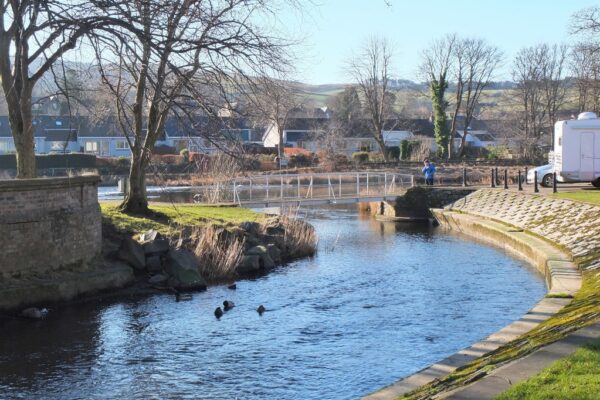
Image: The popular Cobby riverside walk runs below Chalkheugh Terrace in Kelso © Colin Park (cc-by-sa/2.0) geograph.org.uk/p/6012090.
This story was submitted from the collection of David Welsh, a local historian and River Tweed enthusiast, to encourage discussion on the communities of the Tweed and their impact around the world. If you have any more information on this story, please get in touch with us at info@destinationtweed.org so we can add to the story of the river!