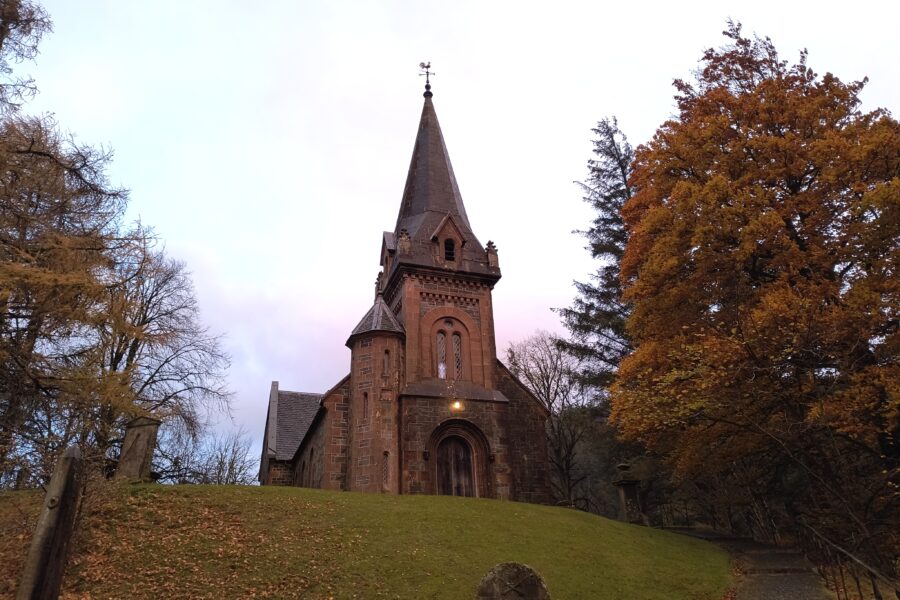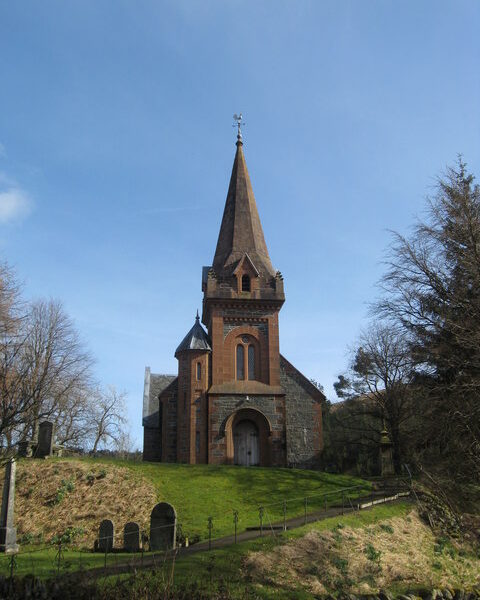
Tweedsmuir Kirk stands in the small, scattered community of Tweedsmuir, just off the A701. To reach it from the main road, cross the river Tweed at Carlowse Brig, and then take a left at the crossroads, which takes you down the lane, through the village of Tweedsmuir past the kirk to the car park.
The current kirk is very attractive, due to the contrast of its grey rubble walks and the red sandstone dressings, and also from the impressive tower. The kirk sits on a small rocky outcrop, Quarter Knowe, a site that has been home to many earlier generations of churches and sites of worship. In the Bronze age it is thought that Quarter Knowe was a significant religious site, and in the 3rd century BC it was a site of Druid worship, and there may even have been a druid temple here.
Holyford
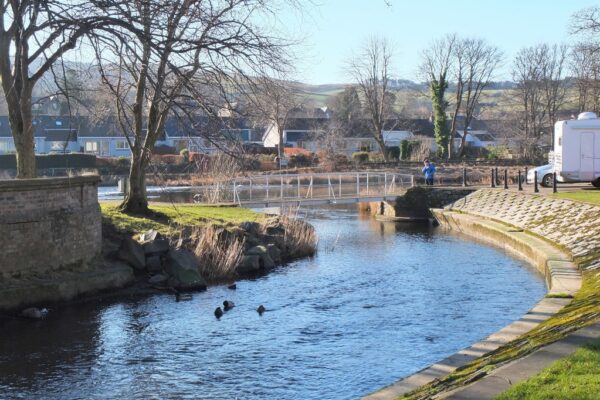
There was a ford across the River Tweed near the church known as Holyford. There were also stepping stones here. Holyford was the only crossing across the Tweed allowing access to the Kirk until the original Carlowse Brig was built sometime after 1694.
First Minister of Tweedsmuir New Kirk
Rev. Alexander Trotter arrived in Tweedsmuir in 1644. He originally came from Barra and was married to a daughter of Mr. David Ogill, who was a minister in Barra, and they had at least one son called Thomas. However, his wife died while his son was still a child.
He held services in the manse until the Kirk was completed, four years after he arrived in Tweedsmuir.
Mr. Trotter was the minister in Tweedsmuir for 17 years and died in 1661 when he was 63 years old, in extreme poverty. He did not receive payment from his posting while he was in Tweedsmuir and when he died his house was in ruins.
In 1662 the Old Glebe (the manse) was built in the current car park, and you can see the date stone from this building inside the Kirk today. At some point in the 18th or 19th century the graveyard was topped up with soil. As the graveyard became full, two feet of soil was added to allow a new raft of burials. This can be observed as the ground level inside the graveyard is much higher than on the other side of the wall.
Tweedsmuir New Kirk 1648 to 1874
The first custom built Presbyterian Kirk in Upper Tweed. It was very plain, and painted austere white inside, and known as a God Box. It could seat 160 people, plus 30 more in the Communion seats.
This Kirk had a Laird’s loft, a private gallery for family members of the Oliver Estate, with an entrance via an external staircase. In winter the communion seats were removed to allow a stove to warm the Kirk. The Shepherds’ dogs often got too close to the stove, and worshippers could smell the dogs’ hair singeing!
The current Kirk was completed in 1874, although some major renovations were done on the deteriorating building in late 1900s. The graveyard was extended in 1952, and a few years later in 1957 the original manse was demolished.
Tweedsmuir Kirk still holds regular services every Sunday, and is host to a beautiful candlelit service on Christmas Eve, when it hosts worshippers from the Upper Tweed congregations for a Family Carol Singing service.
Read more about this story, and many others from the upper reaches of the Tweed, at www.tweedsmuir.scot/history/.
Images: Tweedsmuir Kirk © James Denham (cc-by-sa/2.0) geograph.org.uk/p/1207924 and Jo Scott.