I think what happened was that my grandfather, going for a walk on a Sunday afternoon, saw the deposits of sand and gravel up at Neidpath Castle. He must have thought about it and approached the Earl of Wemyss and they made an arrangement that he could take as much as he wanted for £10 a year.
So he built a boat, I think it was a punt, and he started to bring down the gravel and sand, probably about 2.5 tons at a time, which was about as much as they could manage. I think it was a job for how many labourers, and a couple of guys quietly going to do it.
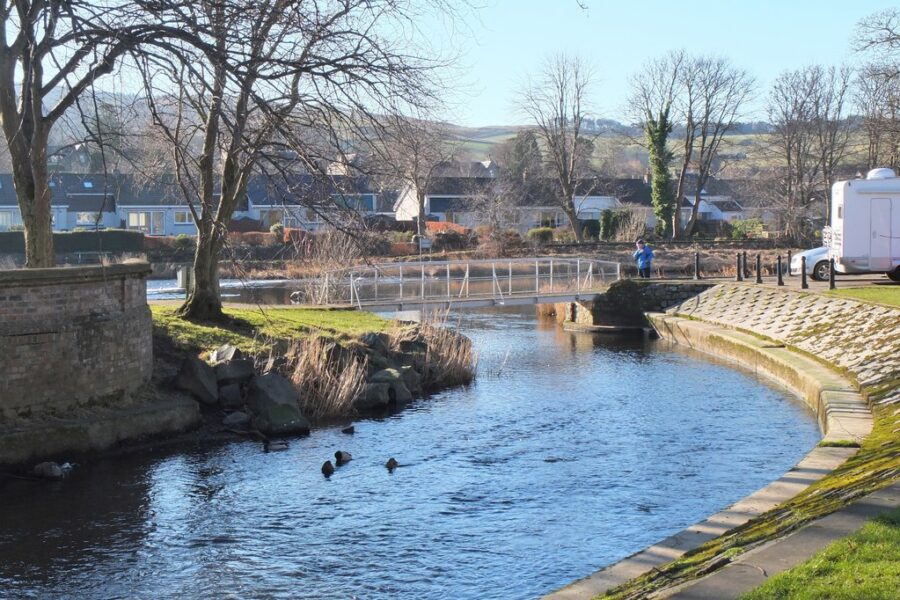
The stuff was brought down and taken off where Cuddy [Eddleston Water] meets the Tweed, a place which we called the Boat Hole. The cauld [weir] was there at the time, and the boat was actually moored up where the bridge goes over to the car park. I think there’s still a hook in the wall where it was attached.
The first boat for one reason or another was damaged, but the second boat ran on till 1939 because Father once took me up where they were filling it with sand and gravel and I got a lift all the way down. During the war, I don’t know the story properly, but there must have been a very high flood and the boat either got pulled away or damaged and that was the end of it.
The way they worked is quite interesting. They dug the gravel out of the downstream side of the gravel bed next to the bank and put the sand and gravel on board. That left a sort of little channel with water in it, and the next flood that came along filled it up again. Providing your extraction rate wasn’t too high, which obviously it wasn’t, it was regularly filled up and it would go on forever.
Before the end of the war, the gravel business was dying away. You get the coarse stuff for making concrete and the fine stuff with sand. In fact, somebody said to me that they regarded part of the success my grandfather had with lime plaster was in using this coarse sand, which was more beneficial for a lime plaster. You can get very fine sand which goes too hard.
Grandfather did all the plasterwork at The Hydro when it was rebuilt after the fire in 1905. They tried to get the fire brigades down from Penicuik and Edinburgh but the only message they could send was by the railway telegraph, Morse code. The guys who knew Morse code were off duty, so the message wasn’t received till the next morning.
But Father, who was about 6 years old at the time, told me that all he could see was just flames over the tops of the trees. Mind you, the trees weren’t as tall as they are now.
Leonard Grandison was born in Peebles in 1931. He joined the family firm of plastering contractors in 1948 and, apart from National Service, was involved with the business until he retired in Peebles in 1996.
Leonard shared memories of growing up in Peebles in the 1930s, which were recorded in the early 2000s. They are reproduced here by kind permission of The Tweeddale Society from their 2005 publication ‘Peebles Remembered’. Whitie’s Books and Crafts in Peebles have copies.
Image: Where the Cuddy meets the Tweed today © Jim Barton (cc-by-sa/2.0) geograph.org.uk/p/4348310.